Data Science: Machine Learning
Goal
- AI: emulate intelligence
- machine learning: learn from data
- deep learning: learn with deep neural networks
Neural Networks
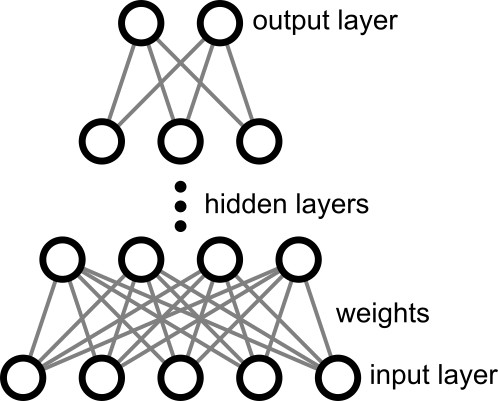
- layers of nodes (neurons) that apply a nonlinear activation functions $f,g,\ldots$ to a linear sum over inputs linked with weights $w_{ij}$ and constant biases $b_i$
- $y_i = f\left(\sum_j w_{ij}~g\left(\sum_k w_{jk}x_k+b_j\right)+b_i\right)$
- originally inspired by brain, diverged, and more recently converged
- exponential expressive power of network depth vs breadth
- feature vector
- input representation of data
- activation functions
- sigmoid
- $f(x) = 1/(1+e^{-x})$
- between 0 and 1, good for binary output
- tanh
- $f(x) = (e^x-e^{-x})/(e^x+e^{-x})$
- between -1 and 1, good for internal layers
- ReLU (Rectified Linear Unit)
- $f(x) = \mathrm{max}(0,x)$
- fixes vanishing gradients, easier to compute
- leaky ReLU
- $f(x) = x$ for $x \ge 0$ and $f(x) = \alpha x$ for $x<0$ and small $\alpha$
- fixes disappearing gradients
- sigmoid
- hidden layers
- internal layers between the inputs and outputs
- output units
- linear for continuous regression
- sigmoidal for binary classification
- softmax for multiclass classification
- loss function
- training goal for supervised learning
- types
- mean square error
- difference between points
- cross-entropy
- difference between probability distributions
- mean square error
- return
- training goal for reinforcement learning
- games won, investment gain, ...
In [1]:
import numpy as np
import matplotlib.pyplot as plt
x = np.linspace(-3,3,100)
plt.plot(x,1/(1+np.exp(-x)),label='sigmoid')
plt.plot(x,np.tanh(x),label='tanh')
plt.plot(x,np.where(x < 0,0,x),label='ReLU')
plt.plot(x,np.where(x < 0,0.1*x,x),'--',label='leaky ReLU')
plt.legend()
plt.show()

Training
- back propagation
- essential algorithm to propagate errors back through the network to perform the weight updates
- gradient descent
- adjust weights to reduce loss function
- learning rate
- the rate at which gradients are used to update weights
- stochastic gradient descent
- for large data sets, adjust weights on random subsets of data points
- batch = subset size
- epoch = pass through entire data set
- momentum
- add inertia to climb out of local minima
- ADAM (Adaptive Moment Estimation)
- adjust learning rate for parameters individually
- L-BFGS
- alternative optimizer using curvature as well as slope, which can converge faster and need less tuning
- early stopping
- stop before loss finishes decreasing, to prevent over-fitting
- dropout
- remove random selections of nodes during training to prevent over-fitting
- regularization
- add penalty to control over-fitting
- L2 for weight norm, L1 for weight sparsity
- pruning
- removing nodes and links with small weights
- quantization
- reducing the bits used to represent numbers, to decrease memory and computing requirements
- vanishing, diverging gradients
- problems in deep networks
- inference
- using models to make predictions after training
Taxonomy
- DNN: Deep Neural Network, MLP: Multi-Layer Perceptron
- a neural network with hidden internal layers
- CNN: Convolutional Neural Network
- a neural network that trains spatial filters to find features
- RNN Recurrent Neural Network
- outputs are fed back to inputs, to be able to learn dynamics
- GAN: Generative Adversarial Network
- a generator network tries to fool a discriminator network, learning how to generate data
- VAE: Variational Autoencoder
- autoencoders connect and encoder network and a decoder network through a lower-dimensional intermediate layer
- they can be used to find compact representations of the data, and to syntheize data
- LSTM: Long Short-Term Memory
- adds memory to handle long-range dependencies
- Transformer
- adds attention to handle long-range dependencies
- LLM: Large Language Model
- trained on a large body of text
- surrogate model
- a model trained to emulate a more complex computation, such as a physical simulation
- Physics Informed Neural Network (PINN)
- AutoML
- automated search over model architecture and hyperparameters
- Agentic AI
- AI systems that can act autonomously on behalf of their users
- SVM: Support Vector Machine
- alternative to neural networks
- can perform better in large dimensions, and can be easier to interpret
- training time is worse for large data sets, $\sim O(N^2)$
- vibe coding: programming with prompts to a LLM
- issues: errors, hallucination, copyright, ...
- need for understanding
- frequently needs debugging
Models
- Hugging Face, Kaggle
- huge model collections
- Edge Impulse, LiteRT
- models targeting edge (embedded) devices
- ChatGPT, Claude, Gemini, ...
- large language models that can write machine learning models
- ONNX
- Open Neural Network Exchange interchange format
Frameworks
- scikit-learn
- easy-to-use high-level routines
- Jax
- PyTorch
- widely used in machine learning research
- TensorFlow
In [2]:
from sklearn.neural_network import MLPClassifier
import numpy as np
X = [[0,0],[0,1],[1,0],[1,1]]
y = [0,1,1,0]
classifier = MLPClassifier(solver='lbfgs',hidden_layer_sizes=(4),activation='tanh',random_state=1)
classifier.fit(X,y)
print(f"score: {classifier.score(X,y)}")
print("Predictions:")
np.c_[X,classifier.predict(X)]
score: 1.0
Predictions:
Out[2]:
array([[0, 0, 0],
       [0, 1, 1],
       [1, 0, 1],
       [1, 1, 0]])
Jax
In [3]:
import jax
import jax.numpy as jnp
from jax import random,grad,jit
#
# init random key
#
key = random.PRNGKey(0)
#
# XOR training data
#
X = jnp.array([[0,0],[0,1],[1,0],[1,1]],dtype=jnp.int8)
y = jnp.array([0,1,1,0],dtype=jnp.int8).reshape(4,1)
#
# forward pass
#
@jit
def forward(params,layer_0):
    Weight1,bias1,Weight2,bias2 = params
    layer_1 = jnp.tanh(layer_0@Weight1+bias1)
    layer_2 = jax.nn.sigmoid(layer_1@Weight2+bias2)
    return layer_2
#
# loss function
#
@jit
def loss(params):
    ypred = forward(params,X)
    return jnp.mean((ypred-y)**2)
#
# gradient update step
#
@jit
def update(params,rate=0.5):
    gradient = grad(loss)(params)
    return jax.tree.map(lambda params,gradient:params-rate*gradient,params,gradient)
#
# parameter initialization
#
def init_params(key):
    key1,key2 = random.split(key)
    Weight1 = 0.5*random.normal(key1,(2,4))
    bias1 = jnp.zeros(4)
    Weight2 = 0.5*random.normal(key2,(4,1))
    bias2 = jnp.zeros(1)
    return (Weight1,bias1,Weight2,bias2)
#
# initialize parameters
#
params = init_params(key)
#
# training steps
#
for step in range(201):
    params = update(params,rate=10)
    if step%100 == 0:
        print(f"step {step:4d} loss={loss(params):.4f}")
#
# evaluate fit
#
pred = forward(params,X)
jnp.set_printoptions(precision=2)
print("\nPredictions:")
print(jnp.c_[X,pred])
step    0 loss=0.3047
step  100 loss=0.0008
step  200 loss=0.0004

Predictions:
[[0.   0.   0.01]
 [0.   1.   0.98]
 [1.   0.   0.98]
 [1.   1.   0.02]]
MNIST
- historically important non-trivial example
scikit-learn
In [4]:
from sklearn.neural_network import MLPClassifier
import numpy as np
xtrain = np.load('datasets/MNIST/xtrain.npy')
ytrain = np.load('datasets/MNIST/ytrain.npy')
xtest = np.load('datasets/MNIST/xtest.npy')
ytest = np.load('datasets/MNIST/ytest.npy')
print(f"read {xtrain.shape[1]} byte data records, {xtrain.shape[0]} training examples, {xtest.shape[0]} testing examples\n")
classifier = MLPClassifier(solver='adam',hidden_layer_sizes=(100),activation='relu',random_state=1,verbose=True,tol=0.05)
classifier.fit(xtrain,ytrain)
print(f"\ntest score: {classifier.score(xtest,ytest)}\n")
predictions = classifier.predict(xtest)
fig,axs = plt.subplots(1,5)
for i in range(5):
    axs[i].imshow(jnp.reshape(xtest[i],(28,28)))
    axs[i].axis('off')
    axs[i].set_title(f"predict: {predictions[i]}")
plt.tight_layout()
plt.show()
read 784 byte data records, 60000 training examples, 10000 testing examples

Iteration 1, loss = 3.36992820
Iteration 2, loss = 1.13264743
Iteration 3, loss = 0.67881654
Iteration 4, loss = 0.44722898
Iteration 5, loss = 0.31655389
Iteration 6, loss = 0.23663579
Iteration 7, loss = 0.19165519
Iteration 8, loss = 0.15617156
Iteration 9, loss = 0.13629980
Iteration 10, loss = 0.11865439
Iteration 11, loss = 0.11459503
Iteration 12, loss = 0.10146799
Iteration 13, loss = 0.09842103
Iteration 14, loss = 0.09300270
Iteration 15, loss = 0.08931920
Iteration 16, loss = 0.08818319
Iteration 17, loss = 0.09585389
Training loss did not improve more than tol=0.050000 for 10 consecutive epochs. Stopping.

test score: 0.958

Jax
In [5]:
import jax
import jax.numpy as jnp
from jax import random,grad,jit
import matplotlib.pyplot as plt
#
# hyperparameters
#
data_size = 28*28
hidden_size = data_size//10
output_size = 10
batch_size = 5000
train_steps = 25
learning_rate = 0.5
#
# init random key
#
key = random.PRNGKey(0)
#
# load MNIST data
#
xtrain = jnp.load('datasets/MNIST/xtrain.npy')
ytrain = jnp.load('datasets/MNIST/ytrain.npy')
xtest = jnp.load('datasets/MNIST/xtest.npy')
ytest = jnp.load('datasets/MNIST/ytest.npy')
print(f"read {xtrain.shape[1]} byte data records, {xtrain.shape[0]} training examples, {xtest.shape[0]} testing examples\n")
#
# forward pass
#
@jit
def forward(params,layer_0):
    Weight1,bias1,Weight2,bias2 = params
    layer_1 = jnp.tanh(layer_0@Weight1+bias1)
    layer_2 = layer_1@Weight2+bias2
    return layer_2
#
# loss function
#
@jit
def loss(params,xtrain,ytrain):
    logits = forward(params,xtrain)
    probs = jnp.exp(logits)/jnp.sum(jnp.exp(logits),axis=1,keepdims=True)
    error = 1-jnp.mean(probs[jnp.arange(len(ytrain)),ytrain])
    return error
#
# gradient update step
#
@jit
def update(params,xtrain,ytrain,rate):
    gradient = grad(loss)(params,xtrain,ytrain)
    return jax.tree.map(lambda params,gradient:params-rate*gradient,params,gradient)
#
# parameter initialization
#
def init_params(key,xsize,hidden,output):
    key1,key = random.split(key)
    Weight1 = 0.01*random.normal(key1,(xsize,hidden))
    bias1 = jnp.zeros(hidden)
    key2,key = random.split(key)
    Weight2 = 0.01*random.normal(key2,(hidden,output))
    bias2 = jnp.zeros(output)
    return (Weight1,bias1,Weight2,bias2)
#
# initialize parameters
#
params = init_params(key,data_size,hidden_size,output_size)
#
# train
#
print(f"starting loss: {loss(params,xtrain,ytrain):.3f}\n")
for batch in range(0,len(ytrain),batch_size):
    xbatch = xtrain[batch:batch+batch_size]
    ybatch = ytrain[batch:batch+batch_size]
    print(f"batch {batch}: ",end='')
    for step in range(train_steps):
        params = update(params,xbatch,ybatch,rate=learning_rate)
    print(f"loss {loss(params,xbatch,ybatch):.3f}")
#
# test
#
logits = forward(params,xtest)
probs = jnp.exp(logits)/jnp.sum(jnp.exp(logits),axis=1,keepdims=True)
error = 1-jnp.mean(probs[jnp.arange(len(ytest)),ytest])
print(f"\ntest loss: {error:.3f}\n")
#
# plot
#
fig,axs = plt.subplots(1,5)
for i in range(5):
    axs[i].imshow(jnp.reshape(xtest[i],(28,28)))
    axs[i].axis('off')
    axs[i].set_title(f"predict: {jnp.argmax(probs[i])}")
plt.tight_layout()
plt.show()
read 784 byte data records, 60000 training examples, 10000 testing examples

starting loss: 0.899

batch 0: loss 0.383
batch 5000: loss 0.239
batch 10000: loss 0.220
batch 15000: loss 0.163
batch 20000: loss 0.167
batch 25000: loss 0.104
batch 30000: loss 0.105
batch 35000: loss 0.092
batch 40000: loss 0.088
batch 45000: loss 0.089
batch 50000: loss 0.079
batch 55000: loss 0.053

test loss: 0.087
(c) Neil Gershenfeld for Fab Futures, 12/14/25